

Complete Buyer’s Guide to Wildland Fire Equipment for Federal Agencies and Municipalities Leave a comment
Why Federal Agencies and Municipalities Need a Dedicated IT Strategy for Wildland Fire Operations
Wildland fire equipment and its season now stretches year-round across much of the American West, Southwest, and Southeast. For federal agencies like the U.S. Forest Service, Bureau of Land Management (BLM), National Park Service, and state forestry departments, the challenge is no longer just fighting fires — it is coordinating vast, distributed operations across rugged terrain where reliable information technology infrastructure and dependable wildland fire equipment can mean the difference between a contained incident and a catastrophic loss of life and property.
Municipal fire departments, county emergency management offices, and tribal governments face the same challenge on smaller budgets with less procurement support. Whether you are outfitting a Type 1 Incident Command Post or equipping a rural municipality with its first dedicated wildland fire communications kit, having the right wildland fire equipment is essential for effective communications, documentation, resource coordination, and incident management. This guide walks you through the critical IT and communications equipment categories, what to look for in each, and how to procure them efficiently through SAM-registered vendors.
1. Rugged Laptops and Tablets for Field Incident Command
The modern Incident Command Post (ICP) runs on data, making reliable wildland fire equipment essential for effective field operations. Incident Action Plans (IAPs), resource tracking through software like IRWIN or I/TEAMS, and real-time fire perimeter mapping all require dependable computing hardware that can withstand demanding field conditions, including heat, dust, vibration, and limited power availability.
What to specify: When selecting wildland fire equipment for field incident command, look for MIL-STD-810H-rated laptops or tablets with a minimum IP52 dust and moisture rating. Dell Latitude Rugged and Panasonic Toughbook lines are widely used for demanding field operations. For tablet form factors, the Dell Latitude 7230 Rugged Extreme and Getac F110 are popular options for Type 1 and Type 2 teams. Battery life of 8+ hours with hot-swap capability is essential when shore power is unreliable.
Procurement note for federal buyers: Many rugged laptops and tablets used as wildland fire equipment are available through GSA Multiple Award Schedule (MAS) offerings from authorized resellers. Request a Trade Agreements Act (TAA) compliance confirmation before ordering. While many Panasonic Toughbook models are available in TAA-compliant configurations, buyers should verify the specific SKU and country-of-origin requirements with their vendor before purchase.
2. Portable Networking Equipment for Temporary Command Posts
2. Portable Networking Equipment for Temporary Command Posts
Establishing a functional local area network at a remote incident command post requires compact, reliable networking gear that non-IT personnel can deploy quickly. As an essential category of wildland fire equipment, portable networking systems help incident teams maintain communications, share operational data, and coordinate resources in challenging field environments. This category has seen rapid improvement, with several platforms now purpose-built for emergency management applications.
Switches and routers: Cisco Catalyst compact switches, such as the Catalyst 1000 series, and Netgear ProSAFE managed switches are commonly considered for deployable emergency networking kits because of their reliability and broad federal contractor familiarity. For routing, Cisco ISR 1100 series routers support dual-WAN failover, which can be critical when a primary satellite or other communications link becomes unavailable during a wind event.
Wireless access points: Ubiquiti UniFi access points, including outdoor mesh models such as the UAP-AC-M, can provide flexible wireless connectivity across staging areas and temporary command-post environments. Cisco Meraki MR series access points are another option for agencies already standardized on Meraki cloud management.
Cabling: Pre-terminated CAT6 and CAT6A patch cables in multiple lengths, including 10 ft, 25 ft, 50 ft, and 100 ft, are essential wildland fire equipment for every deployable IT kit. Consider budgeting for approximately 25% additional cable inventory because cables can be damaged, cut, misplaced, or lost during field operations.
When selecting wildland fire equipment for temporary command posts, agencies should consider durability, ease of deployment, network capacity, wireless coverage, compatibility with existing infrastructure, and the availability of replacement equipment and cables. A properly configured networking kit can help keep incident commanders, planning teams, logistics personnel, and other operational sections connected throughout an extended fire response.
3. Network-Attached Storage (NAS) for Incident Documentation
Wildland fire incidents generate enormous amounts of documentation: daily operational briefings, aerial photography, weather data, medical records, and eventually Burned Area Emergency Response (BAER) reports. Federal incident management teams are required to retain this documentation, and on-site NAS dramatically simplifies records management during extended attack incidents.
What to specify: A 2-bay or 4-bay NAS unit with RAID 1 mirroring, minimum 4TB capacity, and gigabit Ethernet is adequate for most Type 2 and Type 3 incidents. Synology and QNAP both offer units under $500 widely used in federal emergency operations. For Type 1 incidents, a rackmount unit with 8+ bays and 10GbE uplink handles the volume of GIS imagery and daily documentation more comfortably.
4. High-Volume Printers for Incident Action Plans
Every operational period on a federally-managed wildland fire incident requires a printed Incident Action Plan (IAP) covering ICS-202 through ICS-208 forms, maps, medical plans, and communications plans. On a large incident, hundreds of copies may be required per operational period — sometimes multiple times a day as conditions evolve.
What to specify: A high-volume laser printer (HP LaserJet Pro or Enterprise series) capable of 40+ pages per minute with a 500-sheet input tray minimum is the standard specification. Inkjet printers are generally unsuitable due to ink drying issues in hot, dry conditions and significantly slower throughput. If large-format maps are required, a dedicated wide-format printer (HP DesignJet T series) is often included in Type 1 equipment trailers.
Consumables planning: On a 30-day Type 1 incident with 500+ personnel, budget for 3-5 toner cartridges and 20+ reams of paper per printer. Build consumables into your initial procurement package — logistics supply orders for consumables are frequently overlooked until operations are already underway.
5. UPS and Power Conditioning for Remote Operations
Generator power at remote ICPs is notoriously unstable — voltage spikes, sags, and sudden failures are common. Uninterruptible power supplies (UPS) with automatic voltage regulation (AVR) protect your IT equipment investment and prevent data loss during power interruptions.
What to specify: APC Smart-UPS and CyberPower OR series units with AVR are the most commonly specified in federal emergency management deployable kits. Size the UPS for at least 15 minutes of full-load runtime to allow graceful shutdown. Tower-format units work for most ICP deployments; rackmount units are used in trailer-based kits where rack-mounted switches and servers are co-located.
Procurement Pathways for Federal and Municipal Buyers
Federal agencies have several streamlined options for procuring IT equipment for wildland fire operations:
- GSA MAS (Multiple Award Schedule): The fastest route for federal civilian agencies. IT hardware is available under SIN 518210C and related SINs. Emergency acquisition procedures under FAR 6.302-2 can further compress lead times during active incidents.
- Government Purchase Card (GPC/P-Card): Micro-purchases under $10,000 can be made directly from SAM-registered vendors without formal solicitation. One Stop Shop Solutions Inc (CAGE: 9ME14, UEI: QGV1XE1RXLN4) accepts government purchase cards and provides itemized receipts formatted for government reimbursement.
- Blanket Purchase Agreements (BPAs): Agencies with recurring fire season IT needs should consider establishing a BPA with a qualified SAM-registered reseller to eliminate per-order competition requirements for routine purchases.
- State and local cooperative purchasing: Municipalities can leverage NASPO ValuePoint or Sourcewell cooperative contracts to access pre-negotiated pricing without running a full competitive solicitation — a major time-saver for understaffed procurement offices.
Building a Deployable IT Kit: Sample Equipment List
For a Type 3 or expanding Type 2 incident command post, a basic deployable IT kit typically includes: one high-volume laser printer, one 24-port managed gigabit switch, one wireless router or mesh access point, one 4-bay NAS with pre-loaded drives, one tower UPS with AVR, one ruggedized laptop or tablet for the Plans Section, and CAT6 patch cables in multiple lengths. Total procurement cost for a well-specified kit generally runs $3,000–$6,000 depending on brand choices and storage capacity — well within micropurchase thresholds for agencies that plan ahead before fire season.
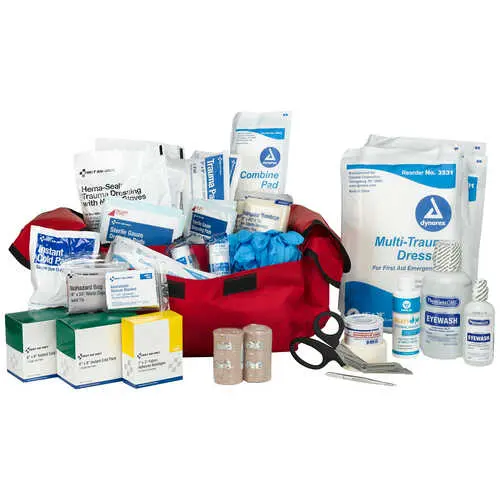
BUY NOW Forestry Suppliers 158-Piece Trauma Kit
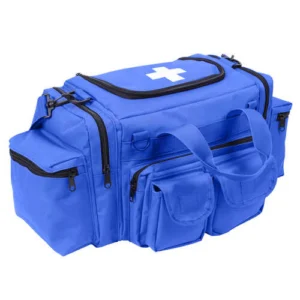
Our other available product is https://www.pinterest.com/pin/1130262837771929863/
Working with a SAM-Registered IT Reseller
Not all IT resellers are set up to work efficiently with government buyers. When evaluating vendors, confirm active SAM registration with a current CAGE code and UEI number, familiarity with government invoicing for IPAC or IPP submission, ability to provide TAA compliance documentation, and availability of NET 30 payment terms for qualifying agencies.
One Stop Shop Solutions Inc is a Delaware-based, SAM-registered small business IT reseller (CAGE: 9ME14 | UEI: QGV1XE1RXLN4) specializing in serving federal agencies, municipal governments, and tribal entities. We stock networking equipment, rugged laptops, printers, storage, cables, and accessories from Cisco, HP, Dell, Netgear, and Ubiquiti — with government-friendly ordering, rapid quote generation, and NET 30 terms for qualifying agencies. Contact us at [email protected] or (302) 567-4434 to build a custom equipment list for your next wildland fire deployment.
