

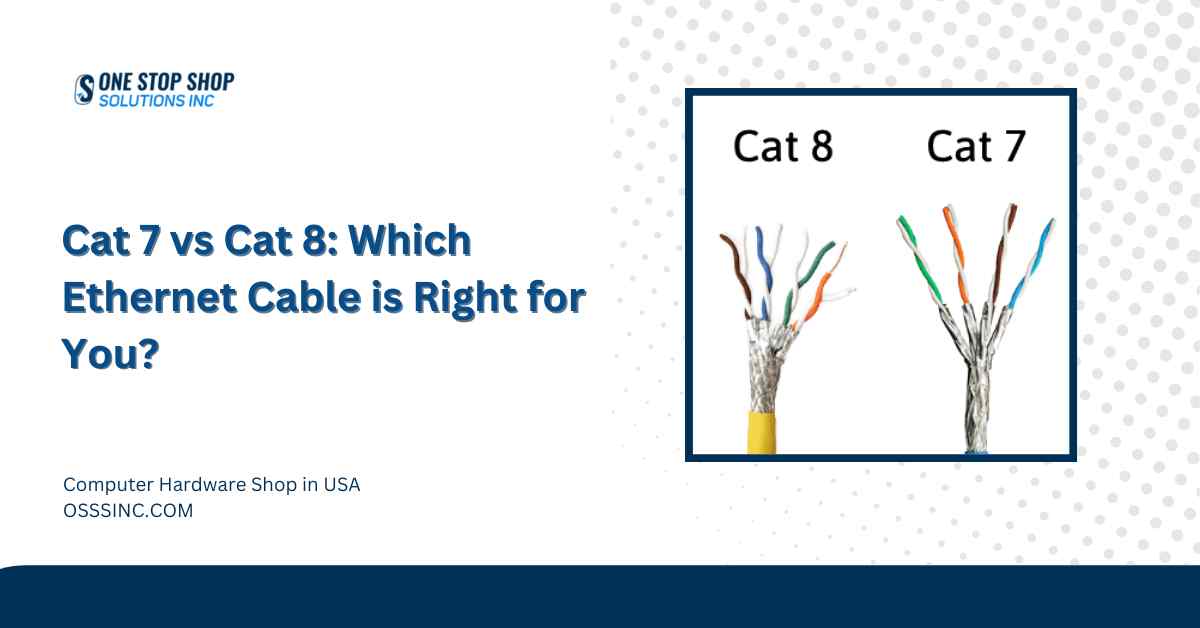
Cat 7 vs Cat 8: Which Ethernet Cable is Right for You? Leave a comment
Introduction
As technology progresses, there is an increasing demand for quicker and more dependable network connections. Ethernet connections are the foundation of wired networks, and with the advent of new standards, it’s important to grasp the differences and advantages of each.
In this article, We will discover difference between cat 7 vs cat 8 ethernet cable, with their pros and cons.

Cat 7
Cat 7 was released in 2002 and is designed to allow high-speed Ethernet connections of up to 10 Gbps. The bandwidth is up to 600 MHz. Individual wire pairs and the entire cable are shielded, which reduces crosstalk and electromagnetic interference (EMI).
Cat 8
Cat 8 is the most recent data center and high-performance computing standard, having been released in 2016. The bandwidth is up to 2,000 MHz. Cat 8, like Cat 7, provides significant shielding for each pair and the entire cable, which reduces crosstalk and EMI.
Cat7 vs Cat8 Ethernet Cable:
Here are some of the Key difference between cat7 and cat8 ethernet cables
| Feature | Cat 7 Ethernet Cable | Cat 8 Ethernet Cable |
| Maximum Speed | Cat 7 speed Up to 10 Gbps | Cat 8 speed Up to 40 Gbps |
| Bandwidth | Up to 600 MHz | Up to 2,000 MHz |
| Shielding | Less stronger | Stronger shielding than Cat 7 |
| Connectors | 4 | 2 |
| Connector Type | GG45 (backward compatible with RJ45) | RJ45 |
| Maximum Length | cat7 max length 100 meters | cat8 max length 30 meters |
| Cost | Lower Cost | Higher Cost |
| Flexibility | More flexible | Less flexible |
| Interference | Minimal interference over 100 meters | Better then Cat 7 despite its short range |
See Cat6 vs Cat6a
Conclusion
Choosing between Cat 7 and Cat 8 Ethernet cables is primarily dependent on your individual requirements. For the majority of residential and small business networks, Cat 7 provides an excellent blend of performance and cost-effectiveness. Its capabilities for 10 Gbps rates and robust shielding make it an excellent choice for a wide range of applications.
However, if you’re setting up a data center or need really high-speed connections over small distances, Cat 8 is the better choice. Its capacity to handle rates of up to 40 Gbps with low interference provides superior performance, albeit at a higher cost and with a shorter maximum length.
FAQs
u003cstrongu003e1- Which cable is better for home use, Cat 7 or Cat 8?u003c/strongu003e
For most home networks, Cat 7 is sufficient as it supports 10 Gbps speeds and has a longer maximum length (100 meters). Cat 8 is typically overkill for home use unless you have specific requirements for extremely high-speed connections.
u003cstrongu003e2- Can I use Cat 7 cables for a data center?u003c/strongu003e
While Cat 7 ethernet cables can be used in data centers, they are typically more suited for home or small business networks due to their 10 Gbps speed limitation. For data centers requiring extremely high-speed connections, Cat 8 is the better choice.
u003cstrongu003e3- Is Cat 8 backward compatible with older network standards?u003c/strongu003e
Yes, Cat 8 ethernet cables are backward compatible with older network standards, including Cat 5e, Cat 6, and Cat 7. This means you can use Cat 8 cables with existing network equipment that supports these standards
u003cstrongu003e4- Why is Cat 8 more expensive than Cat 7?u003c/strongu003e
Cat 8 cables are more expensive due to their higher performance capabilities, including support for up to 40 Gbps speeds and 2,000 MHz bandwidth. The superior shielding and advanced manufacturing processes also contribute to the higher cost.
5- How far can you run cat 7 cable
Cat 7 speed Up to 10 Gbps over 100 meters.
Shop Related Products
One Stop Shop Solutions Inc. is a SAM-registered federal IT reseller offering competitive pricing on networking cables including Cat7 and Cat8. Browse our networking collection | Browse our cables collection. View all products.
